Robotic-Assisted Knee Replacement
Robotic assistance helps your surgeon plan and position your new joint around your own anatomy. Your surgeon makes every decision and performs the operation.

.webp)
Robotic assistance helps your surgeon plan and position your new joint around your own anatomy. Your surgeon makes every decision and performs the operation.
Robotic assistance, experienced surgeons, and a private setting. The technology supports more consistent implant positioning; your surgeon stays in control throughout.

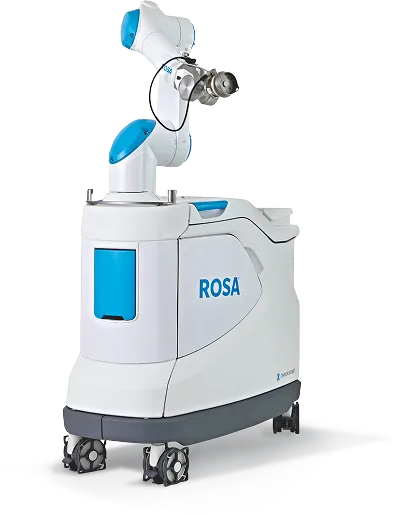
ROSA robotic system
Planning based on your individual anatomy
Real-time data to support implant positioning

More than 20 years of experience
High-volume hip and knee replacement practice
Actively involved in research

Short wait times
State-of-the-art operating room
Personalized care teams and staff
ROSA, or Robotic Surgical Assistant, is a system designed to help your surgeon place your implant following a plan built around your specific anatomy.
It holds the cutting guides where your surgeon has planned them and provides real-time measurements of alignment and soft-tissue balance, while your surgeon performs the operation.
ROSA may be used to aid in hip or knee surgery, for which the benefits may include:
Your procedure is planned around your own anatomy, using imaging or landmarks recorded during surgery.1
The best-supported benefit. Robotic systems place knee implants within the intended alignment target more consistently than manual instruments.2
After robotic-assisted knee replacement, a clinically meaningful improvement may be reached roughly 26% faster, up to 19 days sooner.4
The robot does not move unless prompted and makes no decisions.1

Health evaluation
Candidacy assessment
Personalized surgical plan
Schedule Your Consultation

Medical optimization
Robotic surgical planning
Patient briefing
Recovery planning
State-of-the-art theatre
ROSA robotic system
Real-time monitoring
Same-day discharge if cleared
Immediate monitoring
Coordinated physiotherapy
Progress tracking
Gradual return to activities

%20(1).webp)
ROSA provides robotic assistance to help your surgeon personalize planning and implant positioning around your anatomy.
Standard instruments and templating.
Planning built from your own imaging or from landmarks recorded during surgery.
Accurate in most cases, though more implants fall outside the intended range.
Position falls within the planned target more consistently, in both knee and hip replacement.
Comparable patient-reported results by one year.
Function may improve sooner over the first weeks after knee replacement.
ROSA helps your surgeon personalize your joint replacement to your anatomy, guiding implant planning and positioning and providing real-time measurements during surgery.
The robot does not operate on its own; your surgeon remains in control and makes all decisions.
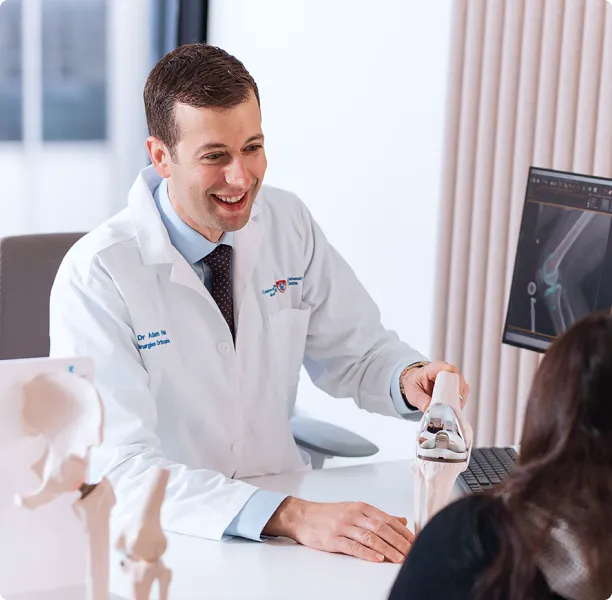
Your surgical team will help you understand your treatment options, determine whether robotic-assisted joint replacement is appropriate for you, and guide you through your recovery.

.webp)
.svg)
"Ortho Westmount's surgical service was awesome. I went in for a hip replacement, and the 2 days spent in the recovery center were great. The staff were all great and made me feel very comfortable and respected. Highly recommended."
ROSA helps your surgeon personalize your joint replacement to your anatomy, guiding implant planning and positioning and providing real-time measurements during surgery.
The robot does not operate on its own; your surgeon remains in control and makes all decisions.
In measurable technical terms, robotic assistance allows for more consistent implant positioning.
Patients receiving knee surgery, for example, may progress somewhat faster over the first weeks, and a recent national assessment concluded that robotic surgery performs at least as well as conventional surgery.
By one year, patients generally report results similar to those who receive conventional surgery.
Most people who are candidates for hip or knee replacement may also be candidates for a robotic-assisted procedure.
Surgery is generally considered when persistent pain and loss of function limit daily activities and sleep, and no longer respond adequately to non-surgical treatment.
A consultation is the best way to find out whether it suits your case.
Most patients stand and walk with an aid within a day of surgery.
Driving is usually possible around 4 weeks after knee replacement and 3 to 4 weeks after hip replacement, though the range varies among patients.
Most improvement in pain and function occurs over the first months, with more demanding activity taking longer.
As recovery is different for everyone, these timelines can only provide general guidance; your surgeon, and any physiotherapist you work with, will help personalize your recovery plan.
Complications caused by the robotic technology itself are rare.
Any harm attributed directly to the device occurs in fewer than 1 in 1000 cases, and a technical or registration problem that briefly prolongs the operation occurs in less than 1 in 500 cases.
Rarely, there is a possibility that the robotic assistance may need to be abandoned partway through and the surgery completed purely by hand, but it remains unlikely as it happens in about 0.003% of cases of knee surgery.
Beyond potential rare machine-related complications, serious complications are uncommon, with a profile similar to conventional knee or hip arthroplasty.
General surgery and anesthesia risks include infection, blood clots, dislocation of the new hip, stiffness, nerve injury, fracture around the implant, and the possibility of repeat surgery.
Overall, however, robotic assistance has been associated with lower complication rates in hip replacement.
Your surgeon will discuss any relevant risks with you before surgery, including any others specific to your health, and how they apply to your individual case.
READY TO LEARN MORE?
A consultation is the best way to find out whether robotic-assisted joint replacement is right for your case.
Your surgeon can assess your condition, discuss your treatment options, and develop a personalized surgical plan.
Have questions about robotic-assisted hip or knee replacement? Get in touch with our team to discuss your options and arrange a consultation.
